Support to Resettlement of Van Gujjars outside Rajaji National Park
In 1983, the Uttar Pradesh State Government
gazetted its intention, under The Wild Life
(Protection) Act, 1972, to create the 820 sq. km.
Rajaji National Park, which is home to endangered species
such as the tiger and the elephant, but the final declaration
of the park has not happened. There are several reasons
for the delay, the principal one being the resettlement
of some 1,390 Gujjar families - a community of traditional
grazers - who, along with over 20,000 cattle, have lived
inside Rajaji.
With the increasing population of Gujjars
and their changing life style, the pressures on forest
resources increased, threatening the very survival of
the park's eco-system and all those who depended on
it.
It became clear some 20 years ago that,
unless these pressures on the forest were reduced, Rajaji
could not remain a home for either the Van Gujjars or
the wildlife. Consequently, the government built a resettlement
colony in the late 1980’s at Pathri, 15kms from
the park. The Van Gujjars were however reluctant to
leave the forest and the colony remained unoccupied
till the late 1990’s, when about 65 families agreed
to move. Now some 400 families, along with 700-800 cattle,
have been resettled in Pathri. Another 185 families
have gone to a colony in Sabalgarh (Gaindikhata), where
it is planned to relocate 878 families from Rajaji and
181 families from Sonanadi WL sanctuary.
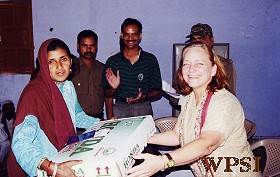
WPSI, along with local NGOs and concerned
individuals, has been encouraging and facilitating this
rehabilitation process, working to ensure that basic
facilities are made available to resettled families.
In addition, in an effort to improve the Van Gujjars'
living conditions, WPSI has been helping them to become
more self-sufficient and less dependant on forests.
All these activities are being carried out in conjunction
with the Field Director.
WPSI’s Project Officer, who is
based in Haridwar adjacent to Rajaji, liaises between
the Gujjar community in Pathri, government officials,
and various organisations to ensure that the resettlement
activities are supported.
Conditions at Pathri have been steadily
enhanced over the past four years. At the end of 2000,
the State Electricity Board regularized electricity
supply and the State Water Board installed 10 water
pumps. The approach road was repaired and a feeding
project for livestock, to reduce grazing pressures,
was launched. WPSI provided the salary for a vocational
training teacher and funds for training materials for
a year. In June 2001, it provided funds to the Gujjar
Eco-Development Committee to form a milk co-operative
and a revolving working capital fund. WPSI also provides
funds to purchase general medicines for the families,
and its project officer co-ordinates medical camps.
To test an alternate fuel source, WPSI
launched a pilot project that provided liquid petroleum
gas (LPG) gas cylinders and stoves to five Gujjar families
at Pathri. This proved to be very effective and in 2003
WPSI received a petition signed by 250 Gujjar families
for further stoves and cylinders. In collaboration with
The Friends of the Doon (FOD), WPSI has also provided
executive and technical support to a dairy development
project.

In view of WPSI’s continued support,
the Forest Department invited WPSI to be part of the
Supervisory Committee for Rehabilitation of Van Gujjars,
which meets periodically with the Gujjar Eco-Development
Committee.
In 2002, the Chief Minister of Uttaranchal
gave WPSI an award for its substantial contribution
to wildlife conservation in the state.
|